
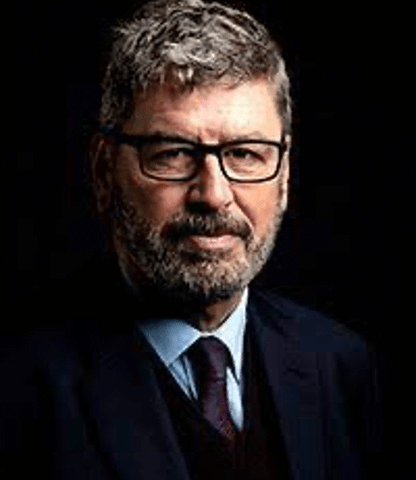
The Extraordinary Story of Richard Hodges,
A World-Famous Archaeologist with Italy in His Heart
November 30, 2025
As President of LoveItaly, this remarkable British scholar leads crowdfunding campaigns, international patronage efforts, and heritage projects dedicated to Italy—the “bel Paese.” His mission is to promote the idea of cultural heritage as something alive, shared, and actively supported by everyone.
by Flavia Taggiasco
“Archaeology is the alchemy of experience”—the moment when “all five senses are challenged and rewarded by something that was buried and completely unexpected.” That one sentence captures Richard Hodges perfectly: a world-renowned archaeologist and a man of boundless, contagious curiosity who has turned his passion into a lifelong journey that has enriched global culture and frequently rewritten whole chapters of post-Roman history. He’s an outstanding storyteller—he’s written more than fifty books—and spending an afternoon with him is like traveling through his adventures, some details fascinating and educational, others downright hilarious. We owe him the protection of the magnificent site of Herculaneum, not to mention the twenty years he spent excavating Butrint in Albania, the frantic race to rescue the Roman city of Zeugma in Turkey from a rising dam, or San Vincenzo al Volturno, often called “the Pompeii of the Middle Ages.” And that’s only part of his incredible body of work.
Among his many honors, he is President Emeritus of the American University of Rome, was awarded the Order of the British Empire (OBE) for his global contributions to archaeological preservation (an award that celebrates not just his scientific achievements but his unique ability to build bridges between cultures, institutions, and communities), and serves as President of LoveItaly, the nonprofit that supports the restoration and promotion of Italy’s cultural heritage through public involvement. Like the best stories, his began by pure chance. As a kid, Hodges was obsessed with rocks. At 15 he joined the excavation of a Roman villa in Box, near Bath in his native Wiltshire, England. The dig was run by Henry Hurst, then a young researcher at London’s Institute of Archaeology (now Emeritus Reader in Classics at Cambridge) and a friend for life ever since.
Henry still vividly remembers that curious, determined teenager: “It was the first site I ever directed. I can still picture that gray December morning—two seasoned workers in cloth caps, wheelbarrows, planks, and sheds already in place. They asked if I’d be okay with a super-enthusiastic kid joining us,” Hurst recalls. “Back then Richard was mainly into rocks—he’d study them in the woods—but he was one of those resourceful kids who knew his home turf inside out. He knew every square foot of the countryside around Box, and to me that local knowledge was pure gold. Even now, when I see him with his long list of accomplishments and published books, I still picture that boy staring at rocks.”
After that first dig, Richard knew his calling was “the ruins,” as he likes to call them. He wanted to join a local archaeology club, but there wasn’t one—so at 16 he started his own: the Box Archaeological & Natural History Society. He was stunned at how easily he got prominent local figures on board. It became a real cultural hub, and to this day he goes back to share his latest research and stay connected to an organization that means the world to him.
Hodges first came to Butrint, Albania—an archaeological site just across from the Greek island of Corfu—at the invitation of Lord Jacob Rothschild, who had founded the Butrint Foundation. Albania in the early 1990s, freshly emerged from half a century of isolation, felt to him “like a movie set right after World War II,” full of loss and anxiety about the future. Yet the moment he mentioned Butrint, people’s eyes lit up. The very first was Prime Minister Aleksandër Meksi—an archaeologist himself—who called the site “a little Troy.” When Hodges finally saw Butrint, he instantly felt its epic scale: “a Homeric landscape,” he wrote. It gave meaning to the almost poetic passion with which Albanians defended their heritage. He ended up giving the place 35 years of his life. Experts still consider it one of the most successful heritage-and-community projects on the planet—a place where archaeology, local people, and landscape blend into one harmonious whole.
His most dramatic adventure in Turkey was at Zeugma, an ancient Roman city on the banks of the Euphrates. Hodges got a phone call on a train from philanthropist David Packard (the man behind Butrint and many other projects) asking if he’d seen the New York Times story about a Roman city about to be flooded by a dam in a matter of days. They had to act fast.
When he arrived, the scene was almost apocalyptic: stunning mosaics baking in the sun, TV crews, volunteers, exhausted archaeologists, farmers watching their history disappear under rising water—and one lone French archaeologist battling the inevitable with nothing but a trowel. It was chaotic, urgent, and deeply emotional. Hodges realized immediately that this wasn’t just about saving mosaics; it was about saving an entire cultural history and landscape. That summer turned into a race against the clock—negotiating with governments, philanthropists, the military, local villages, technicians, and restorers. Photos of the famous mosaics (the Gypsy Girl—sometimes called the Mona Lisa of Zeugma—Oceanus and Tethys, Eros and Psyche) went viral worldwide. That emergency rescue is still taught today as a textbook example of “diplomatic archaeology.”
Italy, however, has always held a special place in Professor Hodges’ heart, proved by the two Italian sites he’s devoted huge chunks of his career to. The first is San Vincenzo al Volturno, a hidden gem tucked among the green mountains of Molise. It was once home to one of medieval Europe’s most important monasteries—a powerhouse of culture, politics, and art that influenced a huge area in the Early Middle Ages. For Hodges, San Vincenzo wasn’t just a research site; it was a chance to bring dignity and attention to a region people often overlook. Today visitors find minimal signage and no hype, but his influence is everywhere: in the reconstructions, the information panels, 1980s excavation photos, and in the way locals talk about Hodges like he’s their savior. Those old photos scattered around the site speak volumes—young Hodges, shirtless in the sun, digging shoulder-to-shoulder with colleagues among rocks and dirt. His natural environment.
His other major Italian love is Herculaneum—less famous than Pompeii but arguably more astonishing because it still has multi-story houses, wooden beams, textiles, everyday objects, and even food remains: an incredibly rare snapshot of regular Roman life. Here Hodges didn’t dig; he focused on conservation—an aspect of archaeology the public often forgets but that’s just as critical. Even tougher was helping philanthropist David Packard navigate Italy’s complicated bureaucracy; Packard ultimately invested over $100 million through the Packard Humanities Institute. Under Hodges’ direction, they created an ongoing maintenance and protection program that has literally saved Herculaneum from decay and environmental damage while allowing new discoveries and giving the site fresh energy.
It’s been an intense, packed career built on unexpected finds that have become cornerstone pieces in rewriting history—a beautiful full-circle journey. Another full-circle moment came, almost poetically, with a single phone call offering him the presidency of LoveItaly. Back then it was a brand-new organization with no track record. For Hodges, it felt like going back to that teenage kid in Box who, with zero experience, had the guts to start an archaeology society and convince respected adults to believe in him. Now it was his turn to return the trust he had received.
Today LoveItaly is widely respected as a bridge connecting museums, scholars, companies, and everyday citizens, mobilizing expertise and funding to restore artworks, reopen forgotten places, and bring lost stories back to life. Through crowdfunding, international patronage, and public-engagement projects, it champions the idea that heritage is alive, belongs to all of us, and can be protected by all of us. Associated Medias – All rights reserved